
A Changing Futures Northumbria case, and what it shows about working from what matters
4 minute read
Changing Futures Northumbria (CFN) is a multi-agency programme working with people facing complex, overlapping disadvantage. Mark Joyce, CFN’s Principal Officer, has worked alongside SIGNAL for five years – a learning partnership that has grown insight as well as a bespoke Life Map co-designed with Experts by Experience, people with direct lived experience of the systems CFN works within.
One choice, and the story behind it
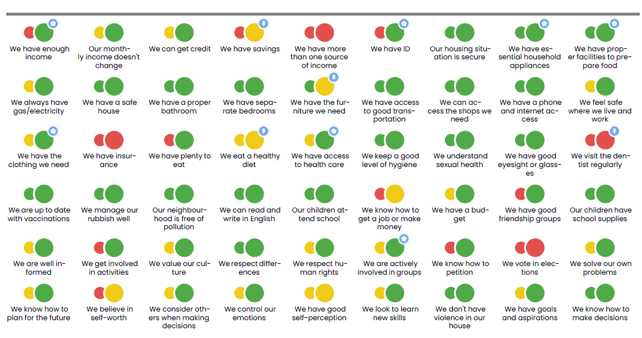
AB’s first Life Map, built in January 2024, has plenty that might have been flagged as urgent by a standard assessment. Savings are red. Credit is red. There isn’t more than one source of income. A service working through a checklist might have gone straight there.
AB chooses something else: ID.
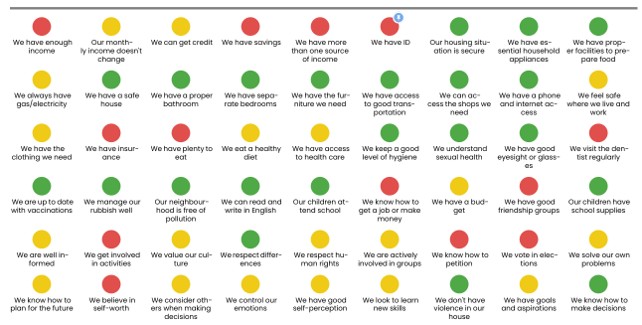
It’s only in building her Life Map that the story behind it comes out. Her driving licence had been taken by a landlord who said she owed him rent. On its own, that could read as one more item on a long list of things going wrong. But AB connected it to something forward-looking – an ambition, quietly held, to one day buy a car and drive again.
That’s the thing a category on a form can’t capture. “ID” wasn’t a bureaucratic gap to AB. It was the thing standing between her and a piece of the future she still wanted.
AB came to CFN through a genuinely difficult chapter – instability, past addiction, and having experienced domestic violence. Support in the early months was intensive: regular meetings, and practical, patient help through some very hard days.
Being heard, first
The point isn’t that naming ID fixed everything else. It’s that AB was listened to – properly, on her own terms – from the very first conversation, in January 2024. What followed over the next six months wasn’t one thing unlocking another. It was several separate wins, each one hers, each one showing the same thing in a different way: that she had been heard and had gone on to act for herself.
What changed by the second map
By her second Life Map, six months later, support had tapered off. AB was doing much of this herself -and her own words carry the change better than any indicator can. These are separate moments, not a chain reaction – four different corners of her life, each moving because she was ready, not because one thing led to the next.
On learning to cook again, after a period of real difficulty around food: “With support and advice I am now cooking again. I had anxiety over whether things were cooked. I would cook and then doubt if it was safe to eat.”
On saving for a washing machine, bought outright rather than any other way, entirely separate from the ID story: “I saved for months from my benefits to buy a washing machine from Currys. I wanted to get it legally and pay for it myself.”
On reapplying for the licence that started it all – the one direct continuation of where she began: “With support I reapplied and paid the fee myself. I want my license back as I’m clean, sober, and hope for a little car.”
On something as ordinary as buying clothes, asked what – or who – had motivated her: “I look for bargains online… Me. I have the patience to look now.”
Four small wins, on paper. In practice, each one is AB doing something for herself, on her own terms -proof repeated four times over, not just once.
Why every case counted
CFN’s approach couples psychologically safe working, learning from practice, and a liberated method built on three rules: stay legal, do no harm, agree purpose. That third rule is the one AB’s story shows in practice. Her purpose wasn’t written down anywhere before she named it herself – a landlord, a licence, a hope of driving again – and agreeing it, rather than assuming it, is what the whole approach turns on.
“What matters is powerful -and it’s what made the liberated approach real, not just aspirational.”
AB’s case isn’t a story picked because it makes a good example. It’s one of many, and every one of them was captured the same way – not curated for the ones that read well but counted because each was real. That’s what turns individual choices like ABs into something a system can actually learn from: not a handful of good stories, but an honest, accumulating record of what mattered to people, case by case, exactly as they said it. Learning from practice like this – built around what matters to people -is what drives sound decision-making, and in turn what should shape policy development and commissioning intentions.
What it asks of the people leading this work
A standard assessment would likely have started with AB’s finances. What actually moved her forward started with a landlord, a licence, and a car she still hoped to drive. Nobody could have put that on a form in advance – it only surfaced because she was given the space, and the trust, to say what mattered in her own words.
That’s what liberated practice asks of the people leading it: trust a caseworker to follow what a person names, ahead of what a service assumes – and build a way of working that captures it honestly, every time, so what emerges across hundreds of cases is real.