4 minute read
The Future Steps Team in Pembrokeshire is a 0-25 prevention and family support service operating throughout Pembrokeshire County Council, with a particular focus on early intervention, supporting children, young people, and families before issues escalate.
A Family facing multiple challenges
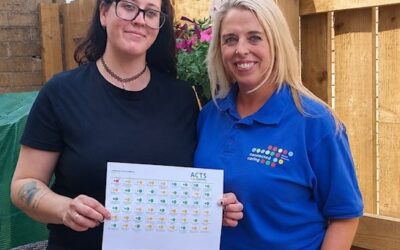
I had the pleasure of meeting with Tina and Tristy from Future Steps.
Tina lives with her husband and her three grandchildren, aged 7, 12, and 14, for whom she has primary caring responsibilities. She manages a number of physical and mental health conditions, including anxiety and depression, and is currently receiving support from Tristy and the Future Steps family support team.
The household experiences ongoing financial pressures, and Tina reports that making ends meet can be challenging. Although she would prefer to maintain a healthier diet, she finds that both the cost of food and her anxiety make the practicalities of shopping challenging.
Tina & Tristy
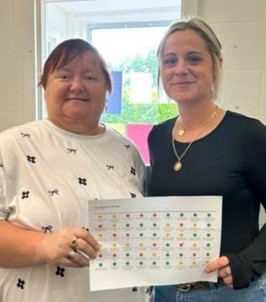
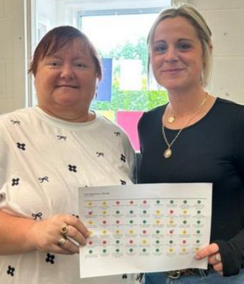
Tina explained that completing her Signal Life Map was an enjoyable and helpful experience. Her Life Map showed her that there were several areas in her life that were green, including a liveable home environment and good access to healthcare. However, it also enabled her to explore areas that were of concern to her. The Life Map shows there are challenges which are contributing to her social isolation. For example, her Life Map shows red responses to Getting Involved in Activities and having Good Friendship Groups. It also opened up a conversation about issues connected to her grandchildren, including how stuck and anxious she felt about addressing sexual health with her eldest grandchild.
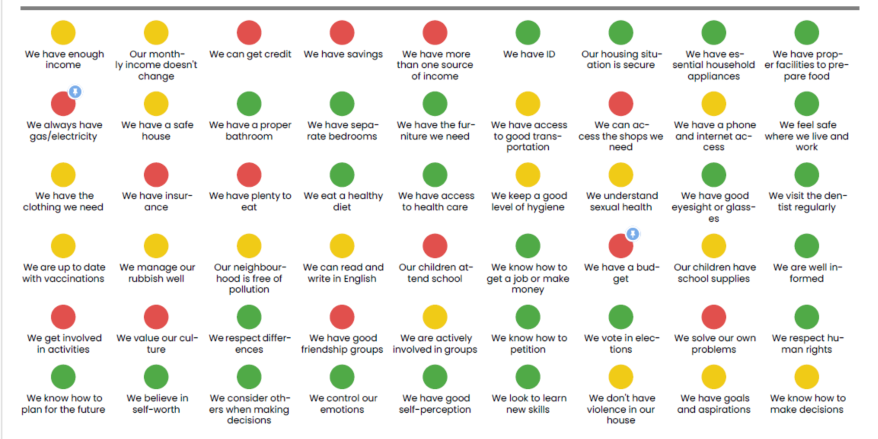
Tina’s Life Map
Turning Insights into Practical Solutions
Having completed the Life Map, Tina and Tristy worked together to develop a plan. Tina identified two immediate priorities: managing her household budget and addressing difficulties related to gas and electricity. The latter issue revealed a specific problem linked to digital exclusion. When Tina was out of the house, her husband was unable to top up the energy meter due to difficulty using the required QR code on his phone. This resulted in periods without heating or electricity. A practical solution was implemented by printing the barcode and attaching it to a key fob, enabling easier access and resolving the issue. Whilst the solution was simple, it exposed a major issue that could have remained unnoticed without the structured conversation which is at the heart of the Signal process.
Alongside these priorities, additional support was arranged for the family. Tristy facilitated contact between Tina’s eldest grandchild and a colleague, Mark, who has since developed a positive rapport with him and is providing mentoring in relation to sex education. This intervention has helped address an area that Tina felt particularly anxious about.
There have been notable personal achievements. For example, Tina recently went to the shops on her own to purchase a birthday gift for her husband. While she found the experience daunting and recognises that it may take time before she repeats it, she expressed a strong sense of pride in overcoming this barrier.
Tina’s Life Map illustrates how the team uses structured conversations that explore all aspects of a person’s life, to build agency.
Turning Lived Experience into System Improvement
Recognising from the outset that the programme would generate valuable learning and insight, Cazine McCarthy, Prevention Programme Manager, established a form of learning governance to ensure that insights gathered through the Life Maps process could be translated into meaningful action. Central to this was the creation of the Systems Insight Forum (SIF), an open forum that brings together practitioners, partners and community members to share observations, discuss emerging issues and explore potential solutions. It provides a space for collective sense-making, ensuring that learning from lived experience can, wherever possible, be translated into action.
Where issues cannot be resolved through the SIF, they can be escalated to the Programme Board, a highly influential group that meets fortnightly and is chaired by Cazine. As owners of the Board, Michael Gray, Director of Social Services, Housing and Public Protection, and Steven Richards-Downes, Director of Education, have backed the programme from the outset, alongside the Head of Performance, Engagement and Community and the Head of Children’s Services. This senior leadership group is uniquely positioned to connect emerging insights with the parts of the system capable of translating learning into practical change. The Board’s role is to synthesise learning from across the programme, identify wider system implications and ensure that issues are directed to the appropriate decision-makers.
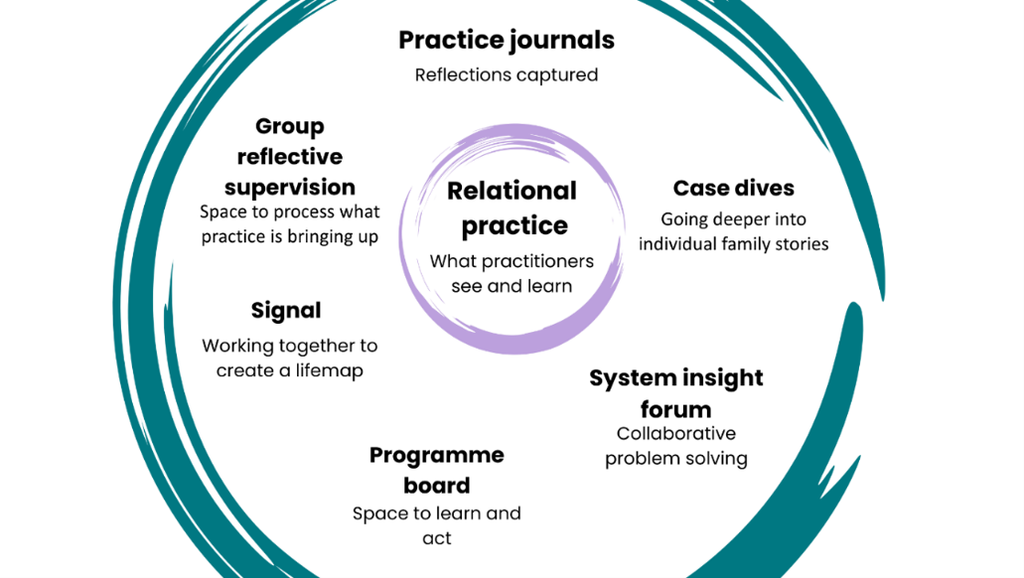
Initially, Cazine conceived this as a linear process. However, she came to recognise that, in practice, the process was far more ‘ad hoc and messy’. So, she reframed the approach as one of relational practice; not a straight line but an inclusive circle. This recognises that valuable learning and insights can emerge from a wide range of people and organisations, and that effective responses are often developed through ongoing collaboration and shared understanding.
“I initially thought of this as a linear process. In reality, it’s ad hoc and messy – not a straight line, but an inclusive circle.” – Cazine McCarthy, Prevention Programme Manager
Cazine
Cazine has developed this simple diagram to illustrate the collaborative, organic non-linear nature of relational practice:
Although the project has been operating for only four months, it has already begun to demonstrate tangible results. Tina’s experience of digital exclusion was discussed by the Board, which quickly recognised its wider significance. The issue was not unique to Tina; many residents, particularly older people, could face similar barriers when accessing essential services.
The Board initially ensured that the issue was raised with the local authority’s housing team and with Ateb, Pembrokeshire’s largest social housing landlord, so that staff working directly with tenants could become more aware of the problem. This is intended to help frontline housing professionals better recognise the signs of digital exclusion and ask the right questions during visits and interactions with residents.
The root cause is now also being addressed directly. In a recent group reflective supervision session, where the Future Steps Team discussed ‘what more can we do?’, engaging directly with the utility companies was identified as the next step to tackle the issue at its source – a practical example of the relational, non-linear practice Cazine describes above.
Given the short period the programme has been operating, Cazine and Tristy view this as a significant achievement, providing a strong foundation for delivering broader and more sustainable system change as the programme continues to mature.
Change the Story, Change the System
Tina’s immediate problem was resolved, but the significance of her story extends far beyond a single successful intervention. Through her experience, a pathway has been established through which the expertise of people with lived experience can inform decision-making, influence services and help prevent similar problems for others.
The Future Steps Team is demonstrating how individual stories can become catalysts for wider system improvement.
We will continue to follow the progress of the Future Steps Team and its influence on the wider system. Watch this space.