

How Changing Futures Northumbria’s Liberated Method Uses SIGNAL to Define Purpose and Track Progress from the Ground Up
This article is based on a conversation between Mark Joyce, Senior Responsible Officer at Changing Futures Northumbria (CFN), and Andy Cox, Director of SIGNAL. It captures key insights from their discussion alongside wider reflections on CFN’s work.
Developing a Common Purpose
How do you get to the heart of what matters to people facing the most complex life challenges—without resorting to rigid assessments that screen them out? How do you build support around what individuals truly need, rather than what services expect to deliver?
At Changing Futures Northumbria (CFN), these questions haven’t just shaped their practice—they’ve driven a three-year journey of reflection, relational working, and intense learning. The outcome? Their own version of the SIGNAL Life Map, built through co-design with staff including people with lived experience.
A key enabler of CFN’s work has always been SIGNAL—a guided self-assessment platform that empowers individuals to take ownership of their journey while enabling staff to understand rather than assess. But in their hands, SIGNAL has evolved. What began as a powerful tool became the foundation for something deeper: a Life Map uniquely shaped by those using it.
From Adoption to Adaptation: Why Create a New Life Map?
Over time, CFN’s staff noticed something. While SIGNAL worked well in principle, some language and framing didn’t fit the realities of the people they supported. Terms like “household” confused people experiencing homelessness. Questions designed for families didn’t match CFN’s one-to-one, person-centred approach.
Rather than work around these issues, CFN addressed them head-on.
“The new Life Map is the result of genuine co-creation,” says Mark Joyce, Senior Responsible Officer. “Our team includes many with lived experience, and they helped make sure the language didn’t take away ownership from the people we support—but helped build it.”
The redesign didn’t come from a top-down directive—it emerged through CFN’s structured learning review process. This reflective space, informed by both frontline insight and real user experience, allowed themes to surface and be explored iteratively.
Co-Design in Practice
CFN’s workforce is made up of 50% staff with lived experience, and more specifically, demonstrable recovery. This brought a depth of insight—and a balance of high support and high challenge—to the redesign process.
Staff worked together to identify areas where language or structure could be changed to make the Life Map more accessible and more engaging—without removing personal responsibility or agency.
This process extended CFN’s iterative approach: what began as reflective practice evolved into full partnership with the people they support.
What Progress Now Looks Like
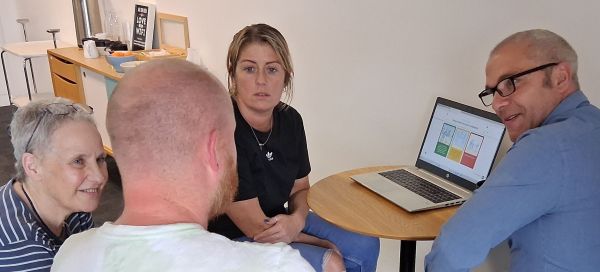
Using SIGNAL over time has shifted how CFN—and those they support—think about progress.
“Change isn’t always linear,” says Mark. “Sometimes, real progress is when someone realises they deserve better.”
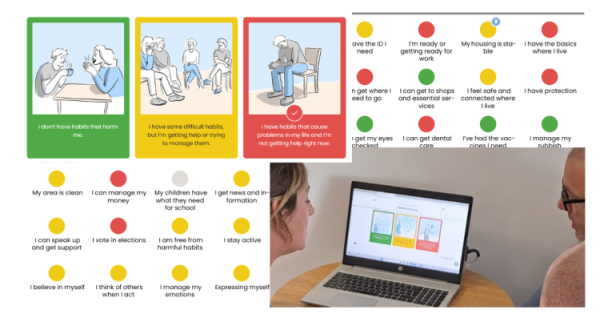
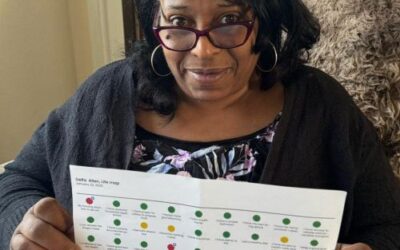
In some cases, a person might move from green to amber or red—not because their situation has worsened, but because their standards have risen. The Life Map makes this visible. It’s not about compliance or scoring—it’s about self-awareness, growth, and increasing agency.
This deeper view of progress strengthens CFN’s relational practice and ensures that support stays aligned with the person’s evolving goals.
How the New Version Is Being Used
The adapted Life Map is now embedded in CFN’s day-to-day work, supported by an operational Playbook that guides staff from initial consent through to helping people thrive.
“We’re curious to see how the new version helps us understand people’s lives more quickly—and how that changes the way we work together to move forward,” says Mark.
The new approach helps surface purpose early, align support more clearly, and track change in ways that feel meaningful to the person—not just the practitioner. It provides space for people to increase agency in ways that work for them.
Why This Matters for Other Organisations
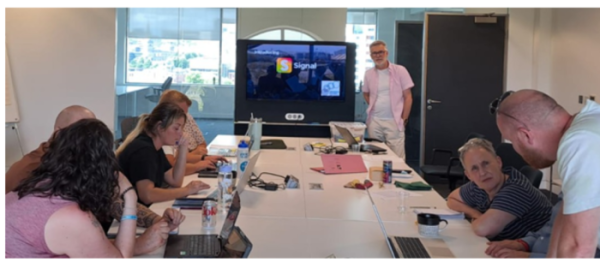
CFN’s journey shows what’s possible when you blend structured tools with relational practice. They embraced Signal by making it their own.
Other organisations exploring SIGNAL are doing so because it:
- Helps individuals share what matters most
- Anchors support in a shared purpose
- Builds trust through meaningful dialogue
- Tracks change in accessible, motivational ways
- Adapts to fit your practice—not the other way around
CFN has done the ‘hard work’. You don’t need to pilot a prototype—you can adopt something grounded in real-world learning.

0 Comments