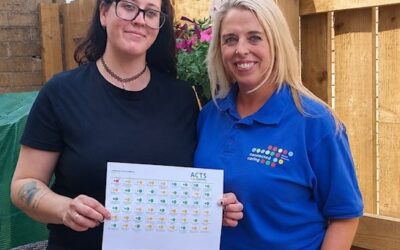

Like many hard-working frontline facilitators, Bianca Rogers from Reviving the Heart of the West End faced a significant challenge at the start of her SIGNAL journey. Often under pressure to keep a program or project ‘on track,’ she wondered, “Is SIGNAL going to be worth using?” Let’s follow Bianca’s story and discover how she found her answer.

“I started working at Reviving the Heart of the West End (RHWE) in 2013 as a Business Admin Apprentice. Having lived in the West End of Newcastle my entire life, I was excited to see an opportunity like this right on my doorstep. In my experience, nowhere else in the area truly offers it all: training and support for people interested in employment or self-employment, volunteering, office space, financial support, crisis help… the list goes on.
“Over the past 10 years, I have built my experience and confidence to support my local community. With the support of Alex, our CEO, who has encouraged me every step of the way, I am now the Enterprise Lead, focusing on helping people start their businesses or grow their existing ones.
“In 2020, I was introduced to SIGNAL. There’s a lot of form-filling in our work, and, honestly, it can be a real pain. My initial reaction to SIGNAL was, ‘Oh dear—another form with many questions! How long is this going to take? …and, Is this going to be worth it?’
“At RHWE, we pride ourselves on finding solutions to people’s problems and overcoming the barriers they face in their lives that might prevent them from achieving their goals. But how do you uncover these issues in the first place? This is where SIGNAL comes in. Some of the questions might seem a bit personal and even intrusive. I initially felt uncertain and sceptical. But as I started to use SIGNAL more, I began to realise its true value.
“SIGNAL is designed to help you understand what’s on people’s minds. It allows you to listen and understand more deeply as a facilitator. SIGNAL covers a wide range of areas, including things I would never have thought to ask about. I’ve been able to assist with many different needs, from practicalities like sorting out personal identification or access to home appliances to addressing personal finances and debt and, most importantly, building self-esteem. Of course, I don’t do this all by myself, but SIGNAL makes it much easier to identify who to bring in for support, whether from within the RHWE team or from our many partners in the area.
“As I used SIGNAL more and more, I learned that it provides the structure to do three key things very effectively:
1. Ask: What matters to you?
2. Listen: To uncover the root causes of what people are struggling with.
3. Agree: Develop a co-designed plan of action.
“The other great benefit is that the data and reporting tools provided by SIGNAL give us the evidence we need to explain to funders why we provide the services we do.
“After reflecting on my experience, I returned to my original question: ‘Is SIGNAL going to be worth it?’ Initially, I wasn’t sure, but now my answer is a resounding YES. In hindsight, I would advise others to understand why you are using it, see how it fits into your organisation’s approach or culture, and then trust the process”.
Thank you, Bianca, for your honesty and for sharing your experience and insights!
We’d love to hear from you if you’d like to discuss your own experience of using SIGNAL. You can reach us confidentially at contact@clearsignal.org, and we’re always available for a personal coaching session.